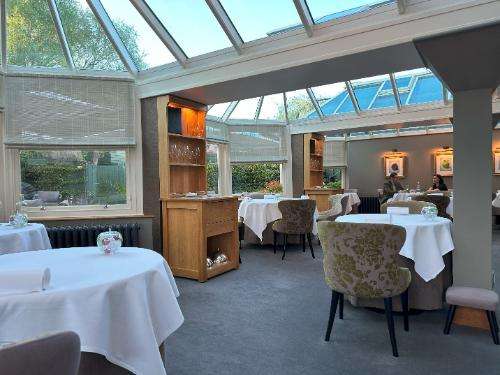
Awards: 2 Michelin Stars, 5 AA Rosettes
Visit: 24 April 2025, dinner for two people
Price: ***
Website: https://midsummerhouse.co.uk/
The Review:
You approach Midsummer House walking over a bridge that spans the River Cam, or walking across Midsummer Common past grazing cattle. The restaurant is on the riverbank next to a large weeping willow. It’s a picturesque setting and only a few minutes from the centre of Cambridge.
Please see my previous review here:
The restaurant was awarded its first Michelin star in 2002, followed by a second in 2004, which have been retained ever since, for an impressive 21 years. The restaurant also proudly holds five AA rosettes awarded in 2014.
The 8-course tasting menu costs £280.00 per person, the lunch tasting menu costs £170.00 per person, and the weekday lunch menu costs £105.00 per person.
There is an extensive wine list available with over 700 references, from 36 different countries. Wines can be ordered by the bottle or glass, and paired wine flights can be ordered. Wine pairings for the lunch menu vary in price from £58 up to £330 for the luxurious selection, and from £135 up to £540 for the tasting menu. Our sommelier was extremely knowledgeable and very helpful with our selection.
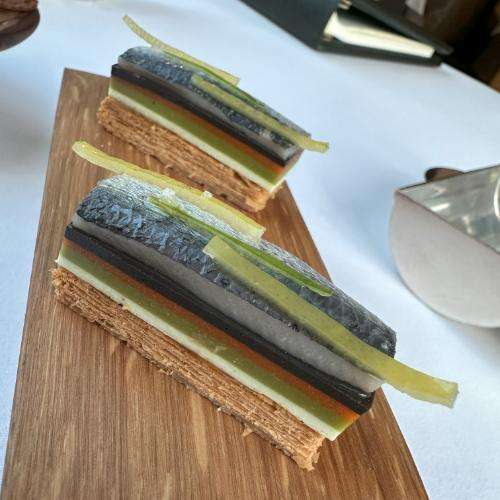
For our 8-course tasting menu we started with a glass of Billecart-Salmon Brut Sous Bois champagne and some very impressive and inventive canapes. There was a truffled sablé with aged parmesan and apple; cured sardine served on a Provencal style tart; and a dark chocolate flapjack with a chicken liver parfait, raspberry and port gel. These had great flavours that complimented and enhanced the flavours of the champagne.
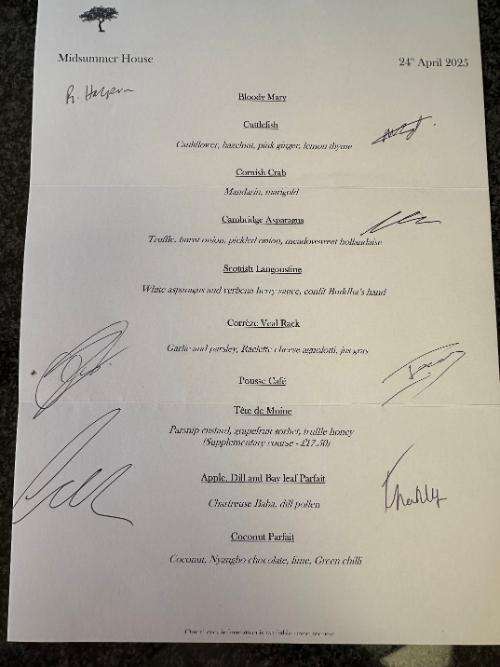
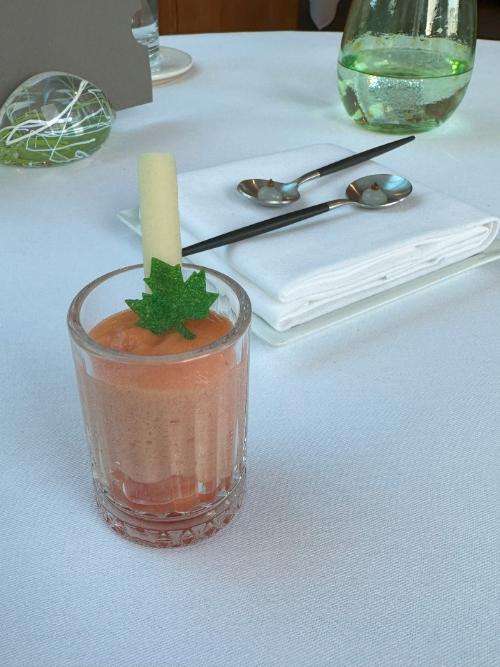
The next amuse bouche was an impressive take on a Bloody Mary. A shot glass contained a Bloody Mary foam with vodka macerated salsa, together with a cylinder of celery sorbet that imitated a straw, and, on the side, a teaspoon with a lime and Worcestershire sauce gel. We dipped the spoon into the shot glass and as we scooped away at the foam we eat the lime and Worcestershire sauce as well, ultimately experiencing the Bloody Mary cocktail. This was visually impressive and had great flavours.
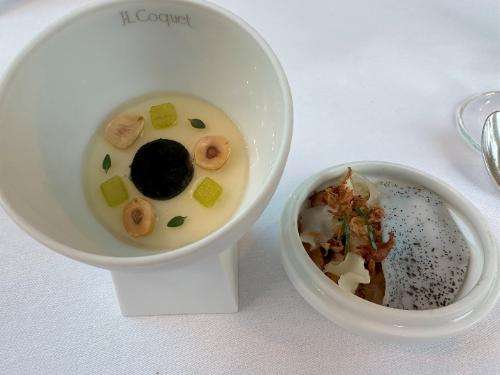
 Lots of restaurants now use porcelain dishes that have a cloche-like lid. This is the only restaurant I have been to that serves different elements of a course in both the bowl and the lid, which is simple but very effective. Our next amuse bouche had a curried version of cuttlefish hidden underneath elements of pink ginger, cauliflower crisp, and salsa verde, together with a layer of cuttlefish, all served in the lid of the bowl, and cauliflower mousse with ginger jelly, nashi pear, roasted hazelnut and lemon thyme, served in the bowl. This was an extraordinary dish. Our waiters carefully lifted the lid off the bowl at the table and placed them side-by-side. The cuttlefish had superb flavours that were complimented by the mild curry and cauliflower. This was one of my stand-out dishes of the night!
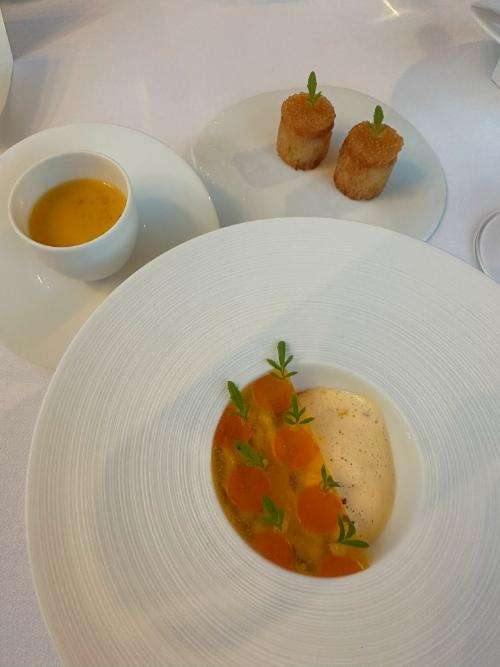
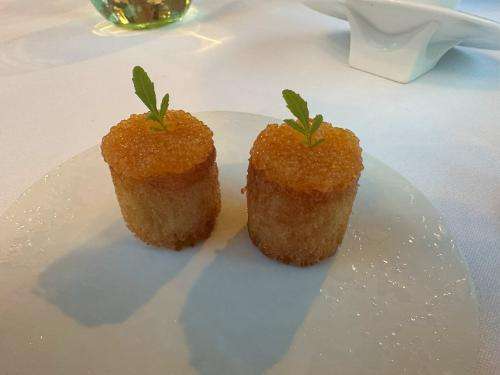
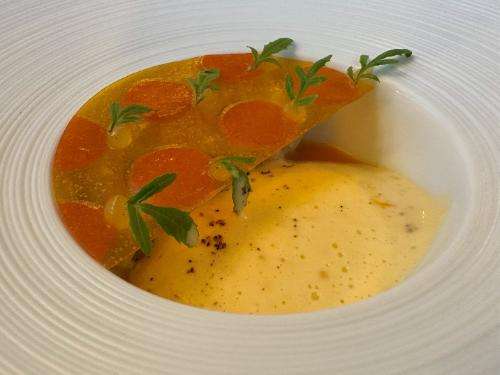
The Cornish crab dish was also extremely impressive. Crab salad was served in a bowl with a creamy crab sabayon, topped with a mandarin and marigold tuille, served with crab toast topped with pike roe and marigold, and a small cup of crab bisque. There were a lot of elements to this dish; it was hugely complex and innovative, and the crab flavours and textures were absolutely sensational and very enjoyable.
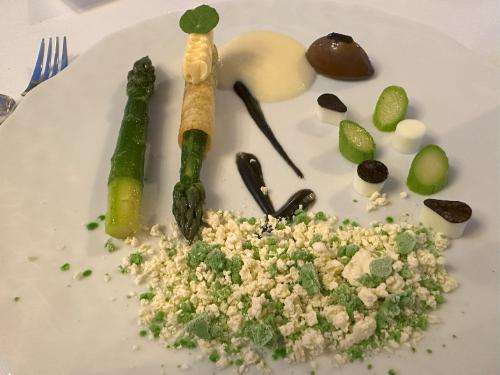
Next was a recently developed dish of locally sourced Cambridge asparagus. One of the asparagus spears was wrapped in a crispy potato cannelloni, and the dish was served with elements of truffle mousse, burnt onion puree, pickled onion, and a cold element of meadowsweet and wild garlic hollandaise snow that had been frozen using liquid nitrogen. All the elements worked together extremely well, and enhanced the asparagus flavours. The contrast of the warm and cold elements was very well judged and enjoyable.
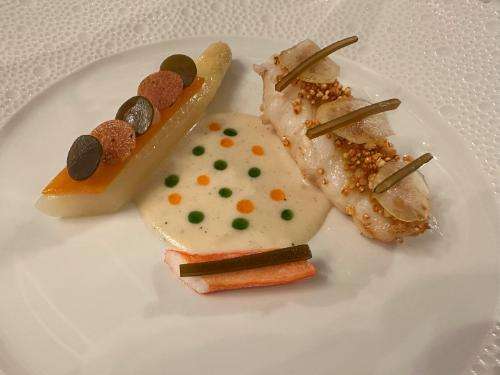
Pan seared Scottish langoustine was served with white asparagus. This included elements of fermented asparagus and verbena berry ajoblanco sauce, together with braised kombu, kombu condiment, and confit Buddha’s hand (a citron type fruit that is segmented into finger-like sections), finished with puffed quinoa grains in a roasted langoustine head and paprika seasoning. The large langoustine was perfectly cooked with naturally sweet flavours. The white asparagus was also exceptional. This was another sensational stand-out dish for me!!
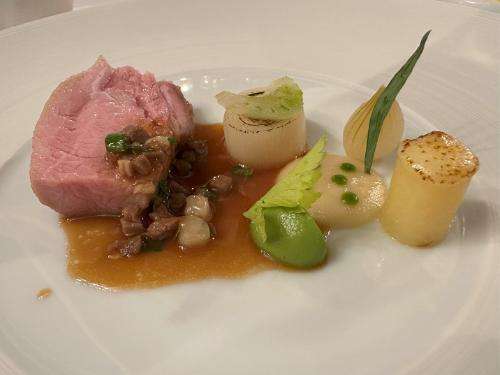
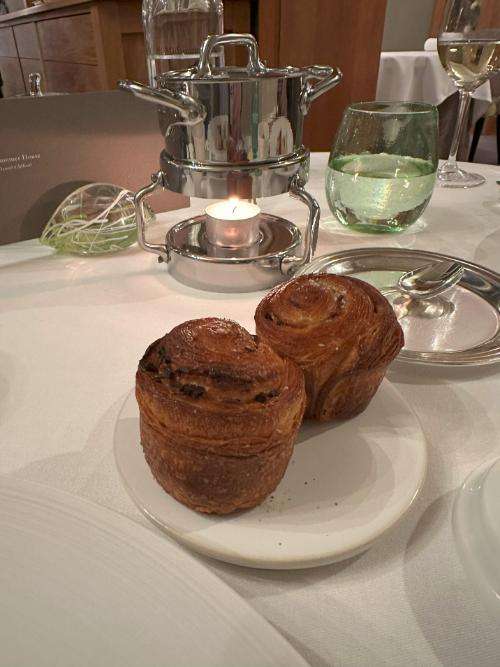
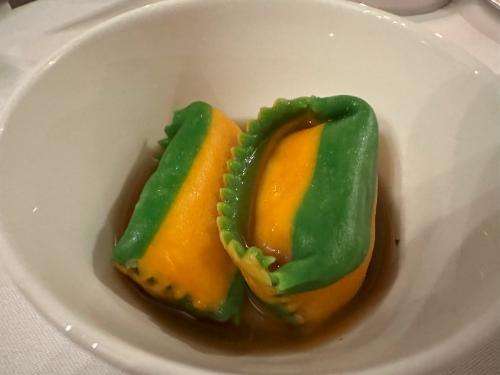
The roasted Corrèze veal rack was served with garlic and parsley puree, braised leeks, confit potato, and a glossy, deep jus gras made with veal tongue finished with smoked bone marrow and flavours of tarragon. There was a Raclette cheese, potato and truffle agnolotti in a roasted veal consommé on the side, and a fabulous bacon and onion brioche roll. Extra jus gras was served in a small pan and kept warm at the table, and we used the brioche to mop it all up. The Corrèze veal was perfectly cooked and had fabulous flavour.
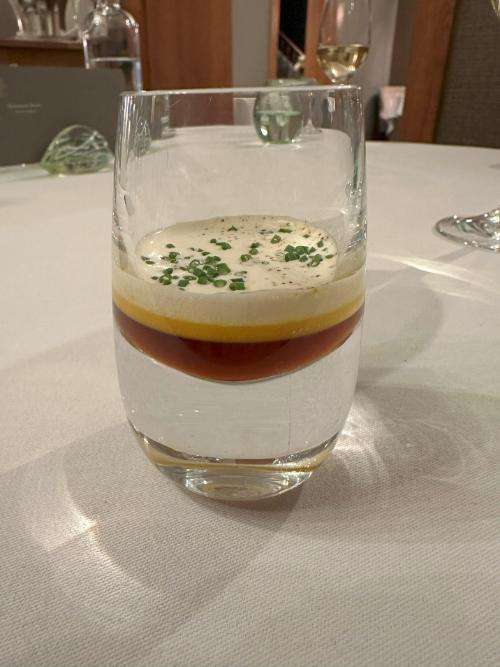
The transition course, was a Pousse Café (French for “coffee pusher”) which was a multilayered cocktail in which each successive layer was clearly defined and displayed in a shot glass. One layer was double cream infused with black pepper, the middle layer was pasteurised egg yolk, and the bottom was maple syrup. This was designed to be drunk in one. It was a perfect transition from savoury to the upcoming sweet courses.
There was an optional dish Tete de Moine (a semi-hard cheese from Switzerland), with parsnip custard, grapefruit sorbet and truffle honey (additional £17.50). We couldn’t manage this tonight!
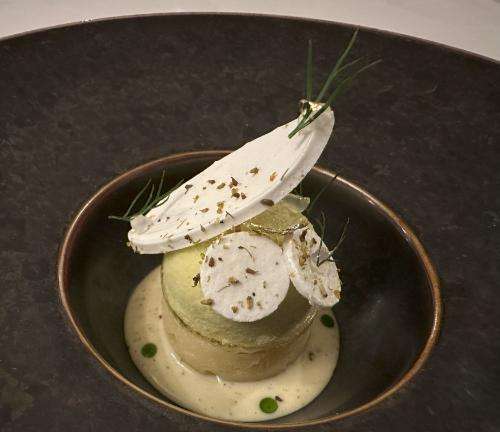
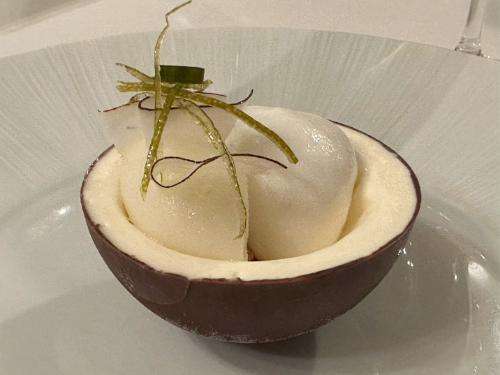
Next, the pre-dessert was a very refreshing apple, dill and bay leaf parfait with a Chartreuse Baba, and dill pollen. The main dessert was a mock coconut with a shell made from Nyangbo dark chocolate lined with a coconut parfait, with a lime sorbet, coconut and green chilli. This is a classic dessert from Midsummer that is extremely refreshing with great coconut textures and flavours.
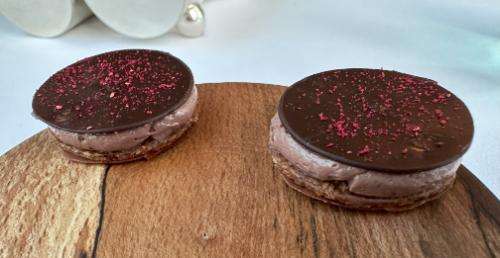
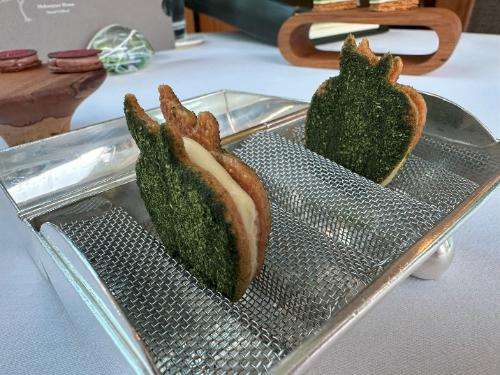
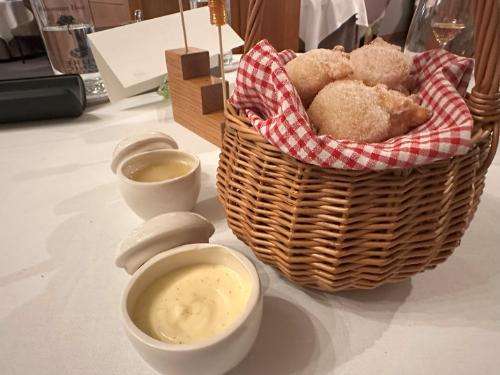
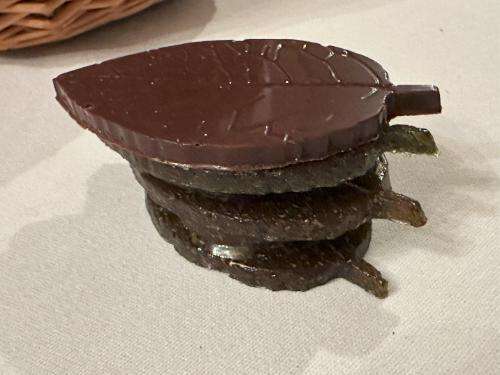
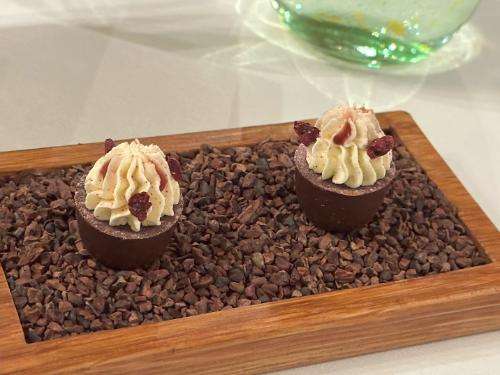
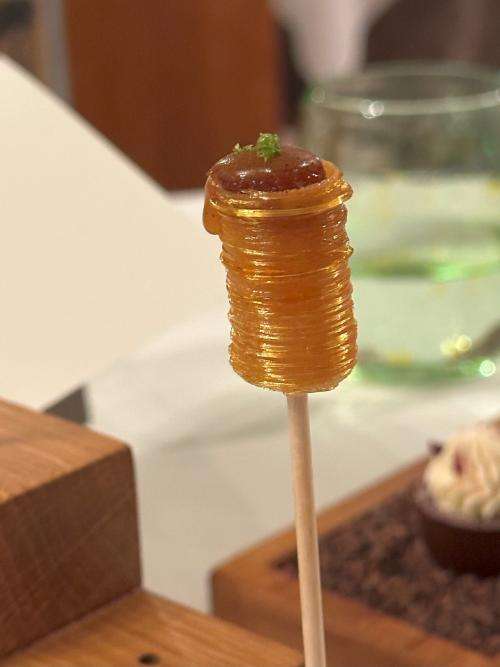
The selection of petit fours included a basket of warm, fluffy and sugar-dusted Bottereaux served with two dipping sauces of apple and vanilla custard. There was an unusual take on an apple tart tatin with spun caramel surrounding a layer of pastry with apple jelly, caramelised apple and a grating of lime zest, all on a stick, like a mini toffee apple. Then a delicious take on a Black Forest gateau that was served as a cup cake with all the traditional elements – cream, dark chocolate, sponge and sour cherry. Finally there was a dark chocolate bay leaf, which was reminiscent of a after dinner chocolate mint. These were all fabulous!
Service throughout the meal was top drawer with great wine suggestions from the sommelier. Katie, the restaurant manager, was especially helpful and took time to explain the dishes to me.
Midsummer House is sensational. The food is complex and inventive, but in a good way; it’s exciting and packed with flavour. This remains one of the top restaurants in the UK and we will be returning very soon.
The Menu:
The Food:
The People:
Chef-Patron Daniel Clifford started as a commis chef at the Howfield Manor Hotel in his hometown of Canterbury, Kent in 1989. Then in 1992 he was the first commis chef at The Bell Inn in Aston Clinton, and in 1993, he became a demi-chef de partie at Marco Pierre White’s Box Tree. He was chef de partie at Millers in Harrogate, sous chef at Provence Restaurant in Hordle, and chef de partie at Jean Bardet’s Le Chateau Belmont Restaurant in Tours. In 1996, he was senior sous chef at Rascasse in Leeds. Then, in 1998, he became head chef in his own restaurant Midsummer House.
Daniel has made it to the Great British Menu banquet on two occasions, winning in 2012 and 2013. In 2012, his dish featured a slow-poached chicken, served with an artificial egg made from sweetcorn, as well as an accompaniment of buttered spinach, bacon and peas. Then, in 2013, his winning dessert was a combination of pineapple cheesecake, coconut sorbet, pineapple textures and piña colada.
On 5 October 2015 Clifford was awarded the Chefs Chef of the Year at the AA awards held at the Grosvenor House Hotel. He was praised for turning Midsummer House into one of the country’s finest restaurants, while being an “inspiration to so many chefs at all levels”.
Liam Anderson has recently succeeded Mark Abbott as head chef at Midsummer House. Liam first started at Midsummer as a teenager and spent five years working his way up from demi chef de partie. He then went on to work with Mark Birchall at Moor Hall, Thomas Keller at California’s The French Laundry, and Mickael Viljanen in Dublin at Chapter One.
The Gastronome with Chef Liam:

Outside the restaurant:

Inside the restaurant: